


EAST ASIA — A significant earthquake with a preliminary magnitude of 7.6 struck the Hokkaido region of Japan at 2:15 p.m. UTC on December 8. The epicenter was located at approximately 41.0 degrees north latitude and 142.3 degrees east longitude, at a depth of 31.7 miles (51 kilometers).
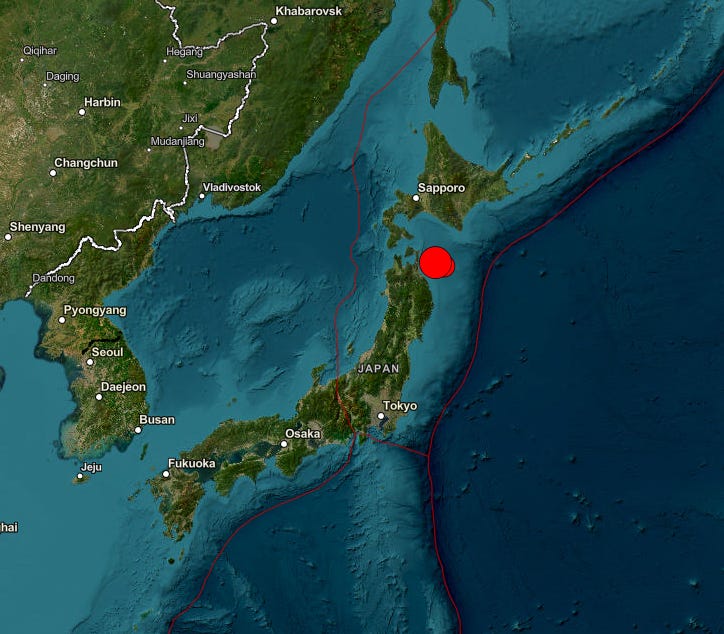
This event prompted tsunami warnings for coastal areas in northeastern Japan, including Hokkaido, Aomori, and Iwate prefectures. Initial assessments indicate potential tsunami waves reaching up to 9.8 feet (3 meters) in some locations, with lower waves forecast for other Pacific regions.
No immediate reports of casualties or major structural damage have emerged from government agencies, continuing to monitor.
The earthquake’s hypo-center was situated offshore, east of Aomori Prefecture, within the seismically active Japan Trench subduction zone. Seismic intensity reached upper 6 in parts of Aomori Prefecture, with strong shaking felt across northern Honshu and Hokkaido.
The Japan Meteorological Agency initially reported a magnitude of 7.2, while the United States Geological Survey assessed it at 7.6, reflecting typical variations in preliminary measurements.
Aftershocks are anticipated in the region, potentially exacerbating risks in affected areas. Tectonic summaries from geological authorities highlight the event’s alignment with historical patterns along the Pacific Plate boundary.
Tsunami warnings were issued promptly following the quake, advising immediate evacuation to higher ground in designated coastal zones. Forecast models indicate waves of 1.0 to 3.3 feet (0.3 to 1 meter) above tide level possible for some Japanese coasts, with lesser impacts expected elsewhere.
Estimated arrival times include Hachinohe at 2:58 p.m. UTC, Kushiro at 3:03 p.m. UTC, and other ports shortly thereafter. The Pacific Tsunami Warning Center emphasized that actual wave heights may differ from forecasts due to local bathymetry (the mapping of underwater features, including seafloor relief, trenches, ridges, and continental shelves) and uncertainties.
Government agencies have activated emergency protocols to monitor and respond to potential inundation. Impacts remain under evaluation, with no confirmed reports of significant damage or injuries from official channels.
Seismic events of this magnitude can cause structural failures, landslides, and disruptions to infrastructure in populated areas. Response efforts involve coordination among local authorities, the Japan Meteorological Agency, and international monitoring centers.
Projections based on historical data suggest a low probability of major aftershocks exceeding magnitude 6 in the immediate term, though vigilance is advised. Analytical assessments indicate alignment with regional tectonic activity, without indications of anomalous triggers.
