


GLOBAL — U.S. officials have publicly detailed intelligence assessing a seismic event near China’s Lop Nur nuclear test site on June 22, 2020, as a low-yield nuclear explosion.


The assessment relies on waveform data from Primary Seismic Station 23 (PS-23) at Makanchi, Kazakhstan, part of the International Monitoring System, a global network of sensors designed to detect nuclear tests.
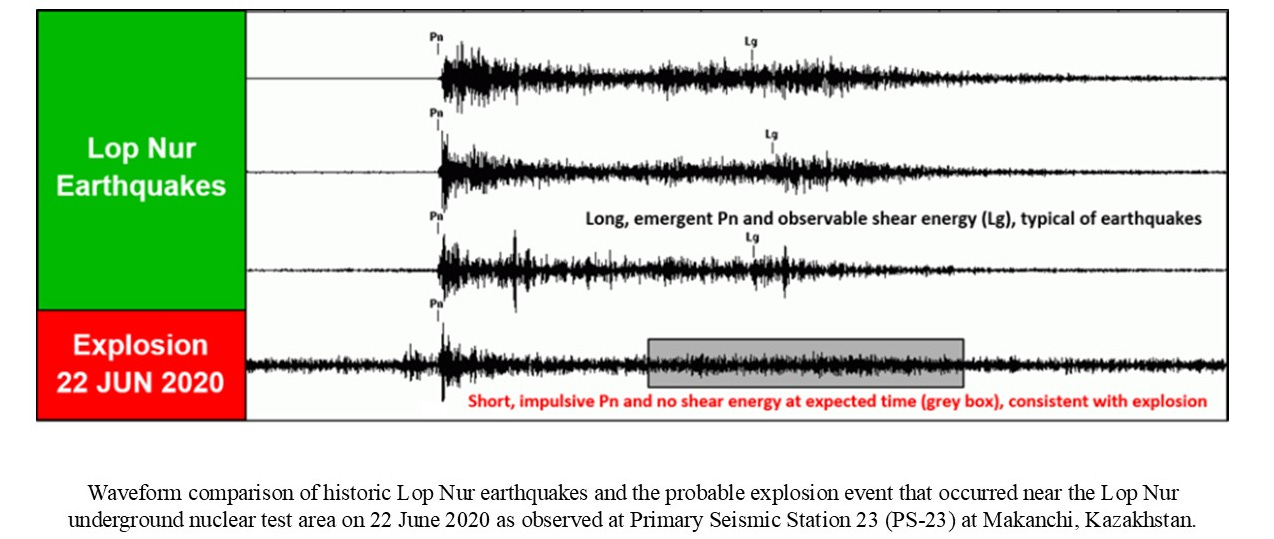
A magnitude 2.75 event was recorded at 09:18 Greenwich Mean Time. Seismic signals showed a short, sharp pressure wave (Pn) — the kind produced by a sudden energy release like an explosion — and no side-to-side shaking energy (Lg) that natural earthquakes normally produce at the expected time.
Historical Lop Nur earthquakes exhibit long, emergent Pn waves and clear Lg shear phases. The 2020 event’s waveform matched explosion signatures in official U.S. comparisons.
U.S. analysts estimate a yield of approximately 10 tons nuclear (or 5 tons conventional equivalent), assuming the blast was fully contained in solid rock — meaning all energy transferred into the ground rather than being absorbed by softer material.
If the test was conducted in a way that dampened the seismic signal (decoupling), the actual yield would be higher than the estimate.