
MIDDLE EAST — President Donald Trump threatened on March 22 to “hit and obliterate” Iran’s power plants, starting with the largest, if the Strait of Hormuz is not fully reopened within 48 hours.


Iran’s military responded that the strait would be “completely closed” if the United States carries out the threat, placing the two sides on a confrontation trajectory over the waterway through which approximately 20% of global oil transits.
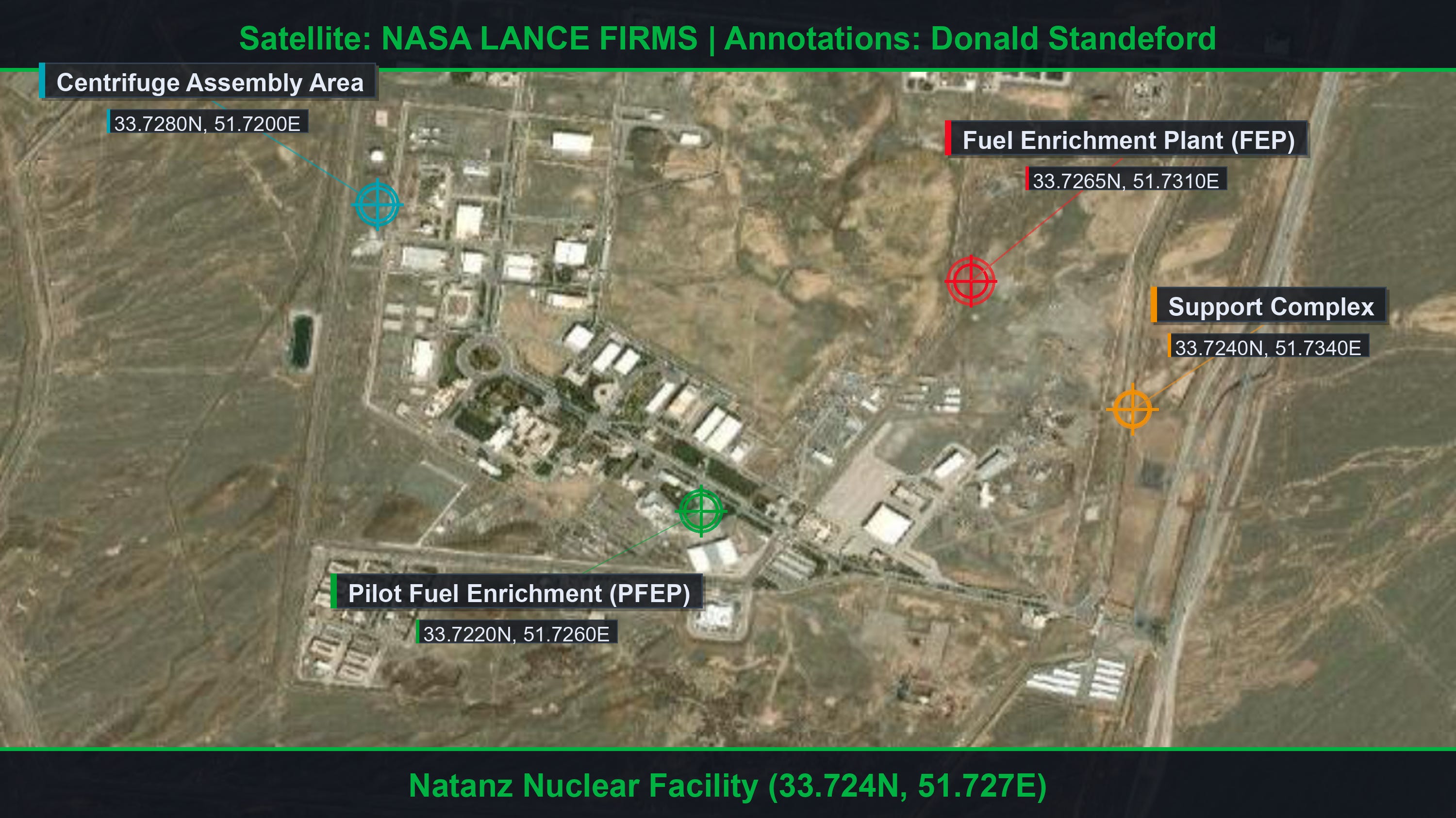
The ultimatum followed two days of nuclear-adjacent escalation on both sides. On March 21, U.S.-Israeli forces struck Iran’s Natanz uranium enrichment facility for the second time since Operation Epic Fury began.
Hours later, Iran fired two intermediate-range ballistic missiles at the joint U.S.-UK base at Diego Garcia, 4,000 kilometers away, demonstrating intercontinental reach for the first time.
Iran then launched retaliatory missile salvos at the Israeli cities of Dimona and Arad, wounding more than 180 people near Israel’s primary nuclear research center.
The IAEA confirmed no increase in off-site radiation at Natanz but warned of “limited changes in radiation levels within the facility’s boundaries.”
Director General Rafael Mariano Grossi reiterated that the presence of over 400 kilograms of uranium enriched to 60% at affected Iranian facilities makes a radiological release “credible, not theoretical” with each successive strike.
More than 1,330 people have been killed in Iran since the war began, including at least 200 children, according to the United Nations.
Assessment: Three converging escalation tracks define the current phase. First, tit-for-tat targeting near nuclear facilities on both sides: Natanz struck by the U.S.-Israel coalition, Dimona struck by Iran. Neither side has hit an active reactor, but the proximity signals willingness to escalate toward radiological consequences.
Second, Trump’s 48-hour power plant ultimatum creates a hard deadline on a conflict that had been grinding without clear endpoints. Iran’s counter-threat to seal Hormuz entirely raises the stakes for global energy markets.
Third, Iran’s 4,000-kilometer Diego Garcia missile attempt demonstrated reach that puts Western European capitals within theoretical range, altering NATO member state calculations about the conflict’s containment.
Watch: Trump’s 48-hour deadline expiration (approximately March 24). Iranian Hormuz closure actions. IAEA inspector access to Natanz underground halls.
